The Science of the Start: 5 Counter-Intuitive Ways to Bypass Task Paralysis
If you are neurodivergent, you know "the gap" intimately. It’s that agonizing space between knowing a task needs to be done—perhaps you’re even holding the vacuum cleaner or staring at the blank cursor—and your body actually moving to do it. You want to start, but you feel physically locked in place.
This isn't a lack of willpower, and it certainly isn't laziness. It is executive dysfunction and task paralysis in its purest form. To your nervous system, a looming task can feel like a predatory threat, triggering an autonomic "freeze" response that shuts down your ability to initiate movement. This guide is your toolkit for hacking that resistance, using the principles of cognitive momentum and sensory anchors to bridge the gap between thought and motion.
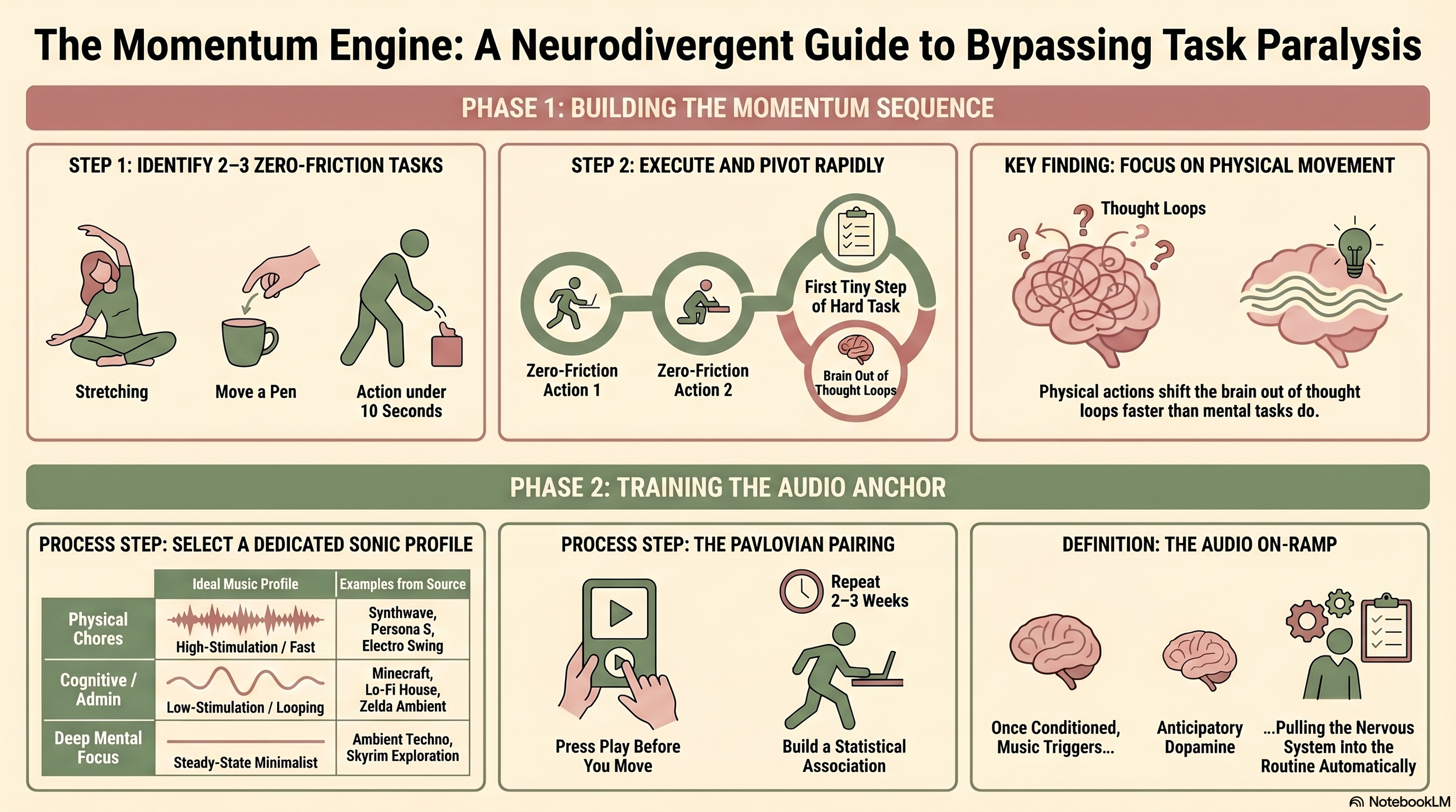
1. Use "High-Probability" Sequences to Trick Your Nervous System
To bypass task paralysis, we use a strategy called a High-Probability (High-p) Sequence. Think of this as an "on-ramp" for your brain. It involves completing 2–3 "zero-friction" tasks—actions so simple they require zero mental effort—immediately before attempting the "Low-probability" task (the hard thing you’re avoiding).
Completing these tiny actions triggers a dopamine kickstart. This small chemical win reduces the friction of the harder task by shifting your brain’s focus from a "threat" to the simple rhythm of movement. It is a powerful way to self-direct your brain out of a freeze state without needing an external "push."
Steps for Self-Direction:
Identify 2–3 "Zero-Friction" Tasks: These must take under 10 seconds and require no "figuring out."
Execute Rapidly: Perform them back-to-back. Don't stop to think; just flow from one to the next.
The Pivot: Use the physical momentum from the last easy action to launch directly into the first tiny step of the hard task.
Example: The Dishwashing Pivot
High-p 1: Put on a favorite upbeat song.
High-p 2: Turn on the tap to warm the water.
High-p 3: Put on your cleaning gloves.
The Hard Task: Pick up and wash just one single fork.
2. The "10-Second Rule" for Zero-Friction Tasks
The secret to the High-p sequence is the Cognitive Load. If a task requires any level of planning, your brain will flag it as a demand and trigger resistance. This is why "Clear the desk" almost always fails—it’s too vague and involves too many decisions.
However, "Move this coffee mug" is a physical, zero-friction action. By keeping the tasks under 10 seconds and purely physical, you bypass the "fight, flight, or freeze" response. You aren't "working" yet; you are just moving your body in space.
"Completing ultra-simple tasks triggers a small dopamine release, which reduces the friction of starting a harder task... physical actions shift the brain out of a thought loop much faster than mental tasks."
3. Understanding the "Switch Cost" (Why Your Brain Lags)
If you feel exhausted after jumping between different projects, it’s because you are paying a literal "biological tax." Research by Schneider & Logan (2007) shows that Task-Switching Costs are not just mental—they are a measurable biological delay.
Their data reveals a linear increase in lag time—approximately 151 to 169 milliseconds of Response Time (RT)—added to your processing for every switch you force your brain to make. For a neurodivergent brain, this "lag" compounds.
The reason for this exhaustion is Mediator-Retrieval. Think of a "mediator" as the mental software or "rulebook" your brain has to load to perform a specific task. When you switch from "answering emails" to "writing a report," your brain has to "close" one program and "boot up" the other. This loading time is what drains your battery. You aren't struggling because you're broken; you are struggling because your brain is doing the heavy biological lifting of reloading its entire operating system every time you switch.
4. Build an "Audio Anchor" to Bypass Executive Function
Because starting a task requires intense conscious thought (which is cognitively expensive), we can use Audio Anchoring to make the process automatic. This leverages your brain’s nature as a "prediction machine."
By playing the exact same music every time you begin a momentum sequence, you engage Statistical Learning. Your brain learns that "Audio Cue A" is always followed by "Movement B." Eventually, the music alone triggers Anticipatory Dopamine, priming your motor pathways to move before you even make a conscious choice. You shift the prompt from an "internal choice" to an "external sensory cue."
The Training Protocol: This isn't a one-off trick. To build a true neural shortcut, you must Pair and Repeat. Press play and immediately begin your 2–3 easy tasks. Do this consistently for 2 to 3 weeks. Eventually, simply hearing the first few bars of that song will "pull" your body into motion automatically.
"The human brain naturally syncs its neural oscillations to external rhythmic beats. A steady, predictable tempo physically alters your attention markers and lowers the cognitive energy required to start moving."
5. Curate Your "Sonic Scaffold"
To save your precious executive energy, match your music to the task's energy profile. The Golden Rule: Lock specific tracks to specific routines. If you use a certain album for laundry, only listen to it while doing laundry to strengthen the Pavlovian link.
High-Stimulation (For Chores & Melting Paralysis) Use these when you are stuck in a deep "freeze" and need external dopamine to get moving.
Video Game Soundtracks: Persona 5 (high-tempo jazz-fusion) or Sonic Rush (hyper-energetic funk). These are designed to keep a player moving and engaged.
Genres: Synthwave or Electro Swing. These offer a driving "four-on-the-floor" beat that acts as an external pacemaker for your body.
Low-Stimulation (For Desk Work & Mental Focus) Use these to provide a "cognitive scaffold" that quiets the restless parts of your brain without overstimulating you.
Video Game Soundtracks: Minecraft (ambient and grounding) or The Legend of Zelda: Breath of the Wild (minimalist piano).
Genres: Lo-Fi House or Ambient Techno. A steady 120 BPM heartbeat creates a "sensory tunnel" perfect for deep work.
Pro-Tip: Always use instrumental music. Your brain will waste executive energy processing lyrics, leaving less fuel for the task at hand.
Conclusion: From Thought to Motion
By utilizing High-p sequences and intentional Audio Anchoring, you can stop fighting your biology and start working with it. These strategies move you away from the exhausting cycle of internal negotiation and into an automatic, rhythmic flow. You are moving the "start" button from your tired executive center to your responsive sensory system.
What if the key to your productivity isn't more willpower, but a better soundtrack and a 10-second head start?