The Architecture of Memory: 5 Surprising Insights from Your Brain’s Internal GPS
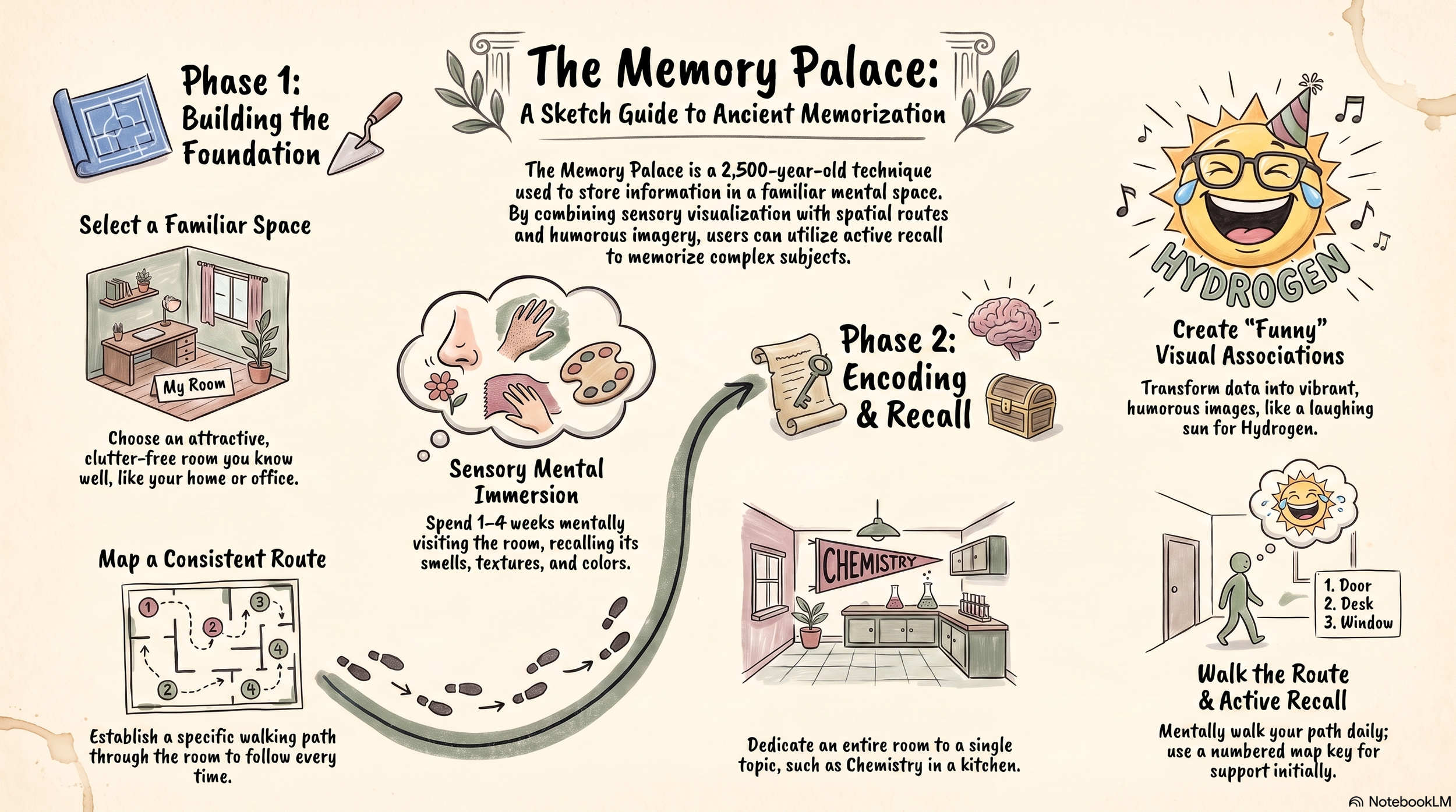
We have all experienced the frustration of a misplaced key or a forgotten name—moments where it feels as though our memories are fragile ghosts haunting a biological machine we don’t quite control. However, the truth is far more grounded in physics than philosophy. For over 2,500 years, masters of the "Memory Palace" (or the Method of Loci) have proven that we can recall vast amounts of data with startling precision by mentally anchoring information to familiar rooms.
While this technique once felt like a mystical oration "magic trick," modern neuroscience has revealed a profound truth: the Memory Palace is not an artificial hack. Instead, it is a sophisticated utilization of how our brains are physically wired to handle information. There is no ghost in the machine—only a highly sophisticated biological map. Our internal GPS doesn’t just help us find the kitchen; it provides the very scaffolding for our intellect.
1. It Started with a Disaster: The Brutal Origin of the Method of Loci
The legend of the Memory Palace begins not in the quiet of a library, but in the gruesome ruins of a collapsed banquet hall. The Greek poet Simonides of Ceos had been attending a feast when he was called outside. In his brief absence, the building collapsed, killing every guest inside.
The scene was a catastrophe; the victims were unrecognizable. Yet, Simonides realized he could identify every person perfectly—not by their features, but by their spatial positions at the table. This revelation—that our brains inherently link identity to location—became the foundation for the Method of Loci. Later adopted by the Roman orator Cicero to memorize complex speeches in an age before paper, the technique relies on the brutal efficiency of our spatial wiring.
Simonides was able to identify his fellow banqueters, despite their bodies being crushed and disfigured. He did so by putting a name to each body in relation to where they had been sitting before the hall collapsed.
2. Your Brain is a Hexagonal Coordinate System
Why was Simonides so successful? The answer lies in the work of Nobel laureates May-Britt and Edvard Moser, who discovered "Grid Cells" in the entorhinal cortex—the gateway to the brain's memory center.
Unlike "Place Cells," which act like mental landmarks (firing when you see a specific object, like your favorite mug), Grid Cells provide a universal coordinate system. They are the brain's internal longitude and latitude. To visualize this, imagine your office floor is made of large, hexagonal floor tiles. As you move, specific grid cells fire at consistent distances, creating a hexagonal pattern that tracks your direction and distance. Remarkably, this system is purely internal; it does not require sensory information like sounds, textures, or visuals to form this framework. It allows the brain to map the structural layout of the world, providing a steady grid even in total darkness.
3. We Navigate Ideas Exactly Like We Navigate Streets
Perhaps the most startling insight from recent research is that we don't just use this hexagonal grid for physical maps. A landmark study from the University of Oxford suggests that the brain uses the exact same "grid code" to navigate abstract thoughts.
In the study, subjects watched a video of a bird "morphing" as its neck and leg lengths were shortened and elongated. Even though the subjects were stationary, their brains activated a hexagonal grid code as they navigated through a "two-dimensional conceptual bird space"—the two dimensions being neck length and leg length. This suggests that the Memory Palace is a natural extension of our biology; our brains are designed to treat categories, hierarchies, and complex ideas as if they were physical rooms we can walk through. We are literally built to map our internal world exactly as we map our external streets.
4. Your Memories "Replay" While You Sleep
To lock in information, the Memory Palace requires "walking" your mental route repeatedly. Neuroscience explains that this repetition is what physically "paves" your conceptual roads. Research on mice by Wilson and McNaughton demonstrated that place cells activated during a maze task will "replay" or "reactivate" during sleep, saving those sequences into long-term memory.
This process of active recall is why I recommend choosing a familiar, clutter-free room and using vibrant, even "absurd" imagery. For example, if you are memorizing the periodic table, you might visualize a laughing sun with a giant "H" on its forehead—because the sun is made of Hydrogen—and place it at the start of your kitchen route. Without this repetitive mental visitation, the "Ebbinghaus forgetting curve" takes over, and memories naturally fade. Repetition ensures that spatial cues remain stable and consistent.
When spatial cues are attributed to memories, whether that be facts or experiences, the retainment of the information is strongest and most consistent.
5. The Future of AI is Hidden in Your Hippocampus
The "universal grid-code" in our brains is now providing a blueprint for the future of Artificial Intelligence. Researchers at DeepMind and UCL trained a virtual agent to navigate a maze using deep learning. Surprisingly, the AI spontaneously developed hexagonal activity patterns nearly identical to the grid cells found in the human brain, suggesting that hexagonal grids are the most efficient way for any intelligence to organize knowledge.
Taking this further, researcher Jeff Hawkins proposes a "Neocortex" model, suggesting these grid-cell-like neurons are spread throughout the entire neocortex. In this view, we use grids to perceive everything. For instance, when you hold a pen, every "sensor patch" of skin on your fingertips and palm is associated with grid cells that process its location relative to the object. Your brain sums up these patches to create an expansive internal map of the pen's features. We don't just use grids to remember; we use them to perceive the very shape of our reality.
Closing: The Map is Yours to Build
Understanding the architecture of memory is not just an intellectual exercise; it is vital for cognitive longevity. Research, such as the Stangl study, shows that the entorhinal cortex is one of the first areas to suffer from neurodegeneration in aging and Alzheimer’s disease. When this region degrades, grid cell stability falters, leading to the navigational decline and memory loss often seen in the elderly.
By practicing techniques like the Memory Palace, you are engaging the very systems that keep your cognitive maps sharp. You are maintaining the integrity of your internal GPS. Our memories are not just a collection of facts—they are a landscape, a territory we must actively cultivate. If your mind is a territory, how will you choose to map it?