The 90% Factor: Why Your Innovation Strategy is Failing Neurodivergent Talent (And How to Fix It for Free)
In the pursuit of organisational excellence, leaders often look toward external market shifts or technological breakthroughs to explain productivity gaps. Yet, the most significant barrier to innovation is often hidden within the company’s own culture.
Recent research underscores a sobering reality: many organisations are currently witnessing a drain on talent and a stagnation of creativity because they lack the strategies to support neurodivergent employees. This is not merely a theoretical business problem. For researchers like Keila Yaremis Molina González, this work is deeply personal, inspired by her son Daniel’s courage in navigating the workplace with ADHD.
To bridge the innovation gap, we must first redefine our perspective. Neurodiversity is not a deficit to be cured, but a "biological variation"—an atypical neurological development that results in profound differences in how the brain processes the world.
To unlock this potential, managers must move beyond basic compliance and toward a sophisticated strategy of environmental alignment. Below are five research-backed takeaways to help you transform neurodiversity from a managed challenge into a competitive advantage.
1. Shift the Blame from the Person to the Process
Sophisticated leadership begins with a mastery of Attribution Theory. This framework examines how we interpret the causes of an employee's success or failure. Managers often fall into the trap of "attributional conflict," where they attribute performance issues to internal, stable factors—such as a perceived lack of "ability" or "motivation"—while the employee correctly identifies external, environmental barriers. Instead of questioning an employee’s capability, leaders must focus on controllability.
While a person's neurological makeup is internal and stable, the workplace environment is highly controllable. By deconstructing complexity and catalysing effort through environmental alignment, managers can resolve conflict and improve performance. An industry training manager would try to understand a situation surrounding an employee based on internal and external factors of ability, motivation, and environment. When a manager stops asking if an employee "can" do the work and begins asking how the environment is helping them "try," they shift the locus of causality from the individual's "deficit" to the organization's "process."
2. The "High-Cost" Myth of Accommodations
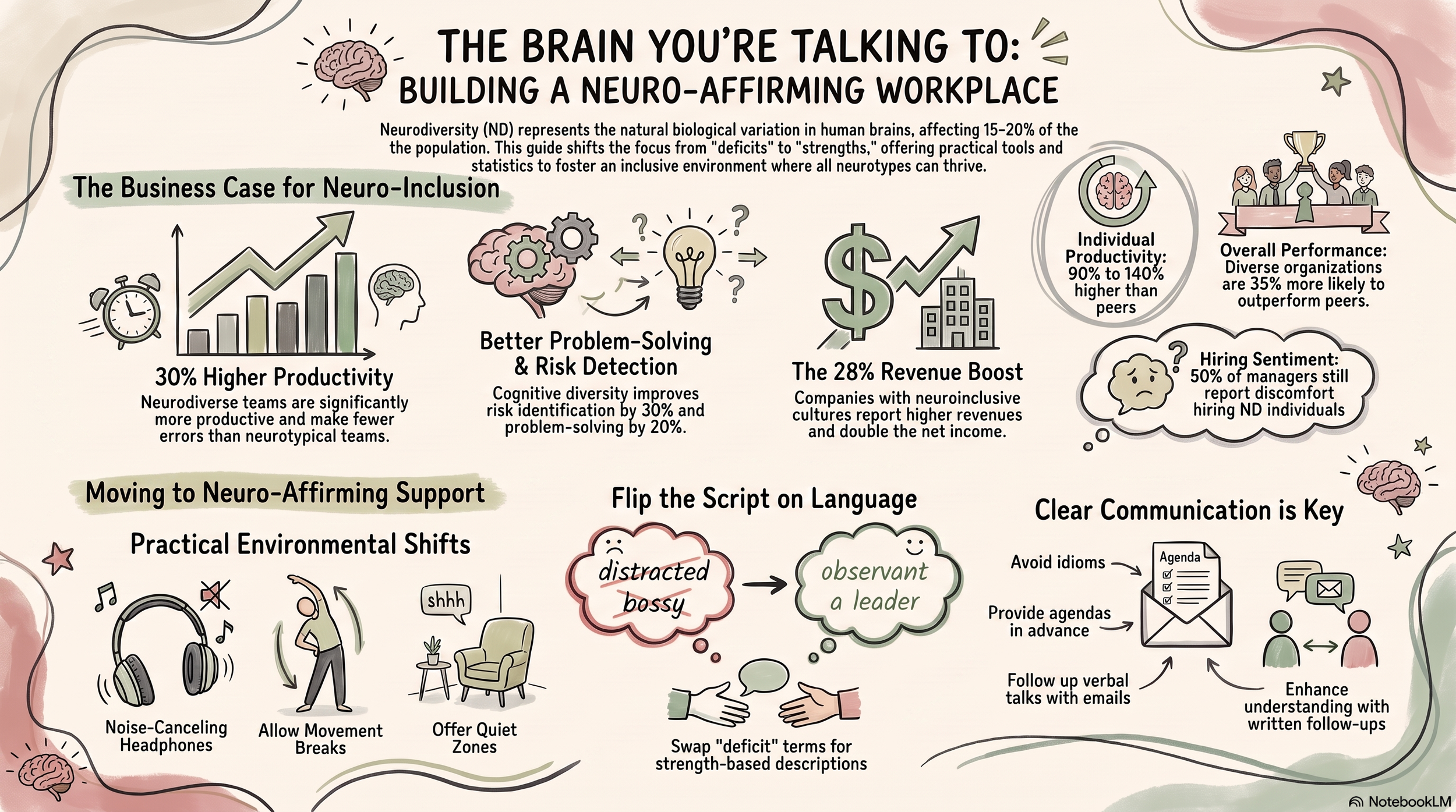
A primary reason leaders hesitate to lean into neuroinclusion is the phantom of high costs. However, the data is unequivocal: 90% of workplace accommodations cost exactly zero pounds. These adjustments are frequently procedural rather than physical. As noted by study participant PD, the real hurdle is not the budget, but "assumed barriers", psychological excuses used to avoid starting the inclusion journey.
To move past these assumptions, managers should utilize objective rubrics rather than subjective "performance vibes." For example, using Takt Time (the rate at which a task must be completed to meet demand) allows a manager to identify exactly where an employee needs support based on data, not bias.
Zero-cost strategies identified in the research include:
Task Segmentation: Breaking a single complex task into ten distinct, manageable steps to provide clarity.
Visual Standardisation: Using visual formats or standardized operating procedures to reduce cognitive load and ambiguity.
Flexible Work Locations: Utilizing quiet zones or remote work to manage sensory processing needs.
Clear Feedback Loops: Replacing daily micromanagement with structured, predictable check-ins.
3. Tapping into the "Creativity Bonus"
Neurodiversity is an innovation engine. Results from the Tolerance Test of Creative Thinking revealed a staggering statistic: 30% of neurodivergent employees scored above the average cut in creativity and innovation. To capture this "creativity bonus," leaders should utilise Job Carving. This process involves identifying the specific, high-level talents of an individual, such as exceptional pattern recognition, analytical precision, or an uncanny eye for detail and tailoring a role to maximise those strengths rather than forcing the employee into a generic job description. By allowing employees to focus on what they do best, you aren't just making an accommodation; you are optimising your firm's innovative output.
4. Building a "Holistic Support Circle"
For many neurodivergent employees, the "social barrier" in a workplace is often higher than the technical one. A counter-intuitive but highly effective strategy for long-term retention is the involvement of external support systems, such as family members or social workers, in professional development. This is a strategic business investment, not a social favour. Programs like the “Parent University” or consulting with guardians help managers understand the specific environments that cause stress or the tasks where an employee flourishes. This "support circle" creates a more sustainable ecosystem, allowing social workers to investigate behavioural barriers while the employee continues to contribute to the team. This collaborative approach significantly reduces voluntary exits and preserves institutional knowledge.
5. Culture is the Ultimate Metric
True support for neurodiversity requires a fundamental mindset shift where "safe work environment" is treated as a critical KPI. Success in this area must be measured with the same rigor as any other business unit, moving beyond simple output to evaluate the health of the process. Key metrics for an inclusive culture include:
Retention and Turnover Rates: Tracking if neurodivergent talent remains in the organisation longer after specific accommodations are implemented.
Current-to-Final State Mapping: Measuring the "current state" of a workflow versus the "final state" after a neuroinclusive strategy is introduced to quantify efficiency gains.
Exit Tickets: Using brief assessments after training to verify that an employee has all the tools and mastery necessary to proceed, ensuring no one is left behind. Ultimately, a safe environment is the bedrock of high performance. A key recommendation is for industry training managers to increase organisational performance through the creation of a safe work environment and support for the individuals on their respective teams."
Conclusion: The Future of the Inclusive Workforce
Neuroinclusive strategies are not an act of corporate charity; they are a blueprint for a more efficient and resilient organisation. When we segment tasks, provide visual clarity, and foster psychological safety, we create a better structure that benefits the entire team, not just those with a diagnosis. The future of work belongs to the leaders who recognise that every brain works differently. If the most innovative solution to your company's biggest problem is currently sitting at a desk you haven't yet learned to support, what are you waiting for?