Why "My Own Time and Space" is the Secret to Autistic Wellbeing: 5 Surprising Insights from New Research
Have you ever felt completely drained after a day in a loud, busy place? For many people, the world feels like a "sensory storm" that never ends. While society often calls the need for solitude "anti-social," new science shows that for autistic people, being alone is a vital health strategy.
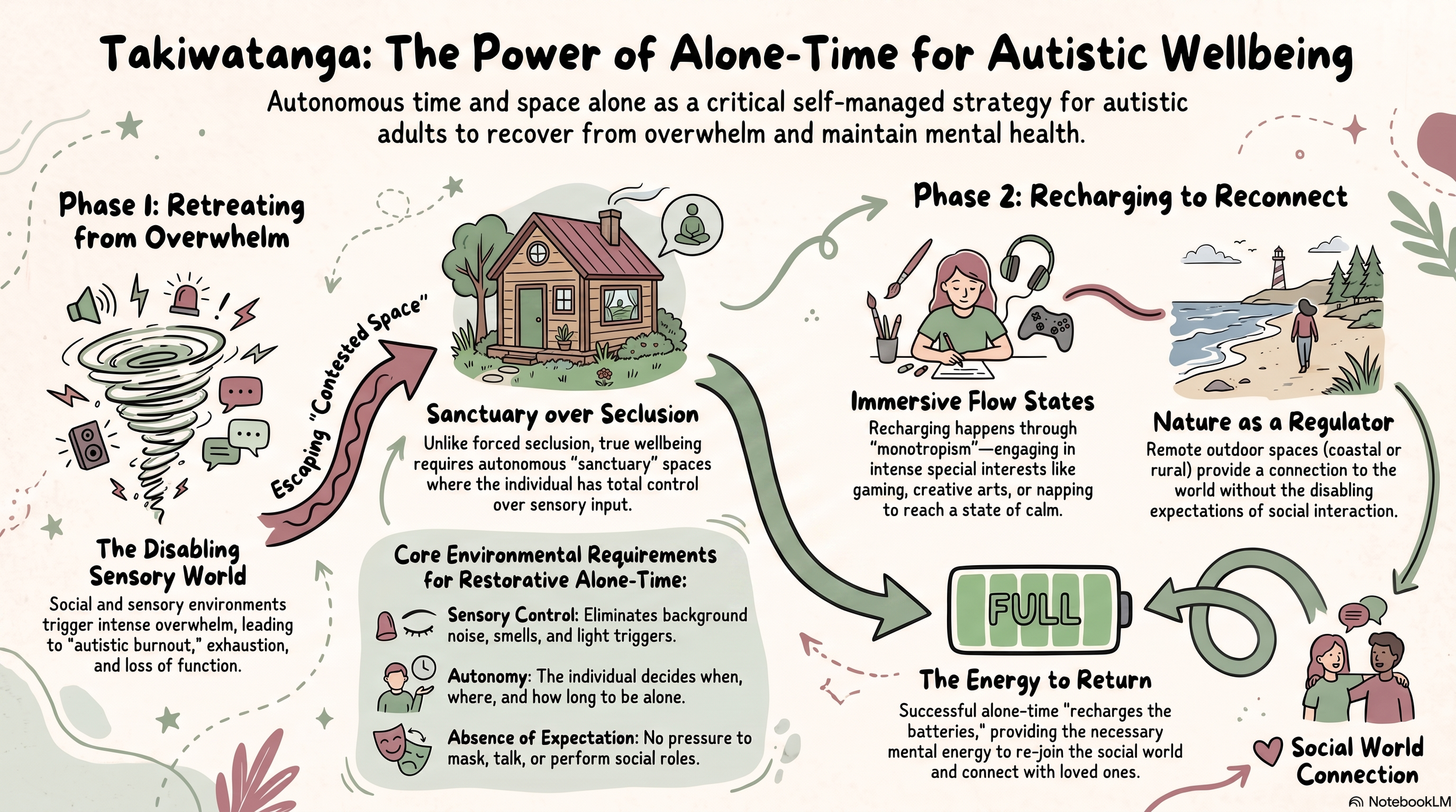
In her 2024 study, autistic researcher Florence Neville changed the conversation. Instead of looking at what is "wrong" with autistic adults, she asked them what they need to feel good. Her work is part of a field called Public Health. This field isn't just about doctors and medicine. It is about understanding how our social world and our environments, like our schools and offices, impact our health. Her research shows that having "your own time and space" is a key to happiness.
Takeaway 1: Autism Means "In My Own Time and Space"
One of the most helpful ways to understand autism comes from the Māori people of New Zealand. Their word for autism is Takiwatanga. This term changes how we think about the autistic experience.
"In my experience, people with autism tend to have their own timing, spacing, pacing and life-rhythm, so I interpreted autism as 'takiwatanga', meaning ‘their own time and space.' , (Keri Opai (2017)).
This definition is beautiful because it doesn't describe a "disorder." Instead, it describes a life-rhythm. When we use this word, we stop seeing someone who is failing to keep up with the world. We start seeing someone who has their own unique way of moving through time and space. Supporting an autistic person means respecting that rhythm.
Takeaway 2: The Difference Between "Retreating" and "Recharging"
Neville’s research found that autistic adults use alone-time in two very important ways:
Retreating: This is about protection. When the world is too loud or bright, an autistic person needs to retreat to a safe space to recover.
Recharging: This is about energy. It involves "flow-state" activities, like getting lost in a favourite hobby or an intense interest. This helps the person feel energized and balanced.
One of the most surprising findings in the study was about the amount of time spent alone. The research showed there is no "magic number" of hours that makes someone feel better. Instead, the secret is autonomy. This means having the freedom to choose when and how to be alone. It is the choice that matters most for wellbeing, not just the clock.
Takeaway 3: The "Double Empathy Problem"
For years, many people believed that autistic people simply lacked social skills. Researcher Damian Milton created a theory called the "Double Empathy Problem" to prove this was wrong. He argued that communication is a "two-way street."
The struggle happens because autistic and non-autistic people have different social languages. Research shows that autistic people actually communicate very well with other autistic people. This proves that social difficulties are relational. The problem isn't inside the autistic person; it is in the gap between two different ways of experiencing the world.
Takeaway 4: The High Cost of "Adaptive Morphing"
Many autistic people feel forced to act normal to fit in. This is often called masking. Researcher Wenn Lawson uses a different term: adaptive morphing. It is an unintentional survival strategy. It involves hiding things like stimming (soothing repetitive movements) or forcing eye contact.
This happens because society often treats typical brains as the only healthy ones. This is a form of social oppression. Trying to fit into a normal mold is exhausting. It leads to autistic burnout, which is a state of total physical and mental collapse. We need to create safe spaces where people don't feel forced to hide who they are just to be accepted.
Takeaway 5: Debunking the "Catch-22" of Autistic Happiness
There is an unfair myth about autism that creates a "Catch-22." It is a trap with two sides. First, some people think that if you are autistic, you cannot be mentally well. Second, they think that if you can show that you are happy, you must not really be autistic.
The Neurodiversity Paradigm proves this myth is false. This way of thinking says that having a different kind of brain is a natural part of being human. Autistic people can and do experience deep happiness. This happiness isn't always talked about in a traditional way. It can be shown through behaviour, or by using Augmentative and Alternative Communication (AAC) tools like tablet apps or letter boards. Being autistic and being happy are not opposites.
A Forward-Looking Summary
True wellbeing for autistic adults is about having the power to manage your own environment. It is about having the autonomy to seek out your own time and space whenever you need it. When we stop trying to make everyone fit the same mold, we allow every kind of brain to thrive.
As we think about the future, we should ask ourselves: How would our schools and offices change if we respected everyone's need for their own time and space?