Beyond "Just Try Harder": The Surprising Reality of Growth Mindsets
We have all met the "gifted child" who hit a wall. They are the ones who coasted through early grades on "natural talent," only to find themselves paralyzed when things finally got difficult. When the easy A's disappeared, they didn’t just struggle; they felt like a fraud. This is the "gifted burnout," and it’s a direct result of the tension between two ways of seeing ourselves.
For years, research led by Stanford’s Carol Dweck has defined this tension through two lenses. Some see intelligence as a fixed mindset—a static, unchangeable trait. Others see it as a growth mindset—the belief that intelligence is like a muscle that develops through effort, strategy, and instruction. But as this concept has gone mainstream, a new problem has emerged. We’ve turned "growth mindset" into a platitude, often telling people to "just try harder" when, in reality, sheer effort can be the very thing that leads to frustration and failure.
Recent data reveals that much of what we assume about "being smart" is actually counter-productive. To truly unlock potential, we have to look past the slogans and understand the rigorous neuroscience of how we actually grow.
1. The Effort Trap: Effort is a Means, Not the End
The most common misunderstanding today is equating a growth mindset with "sheer effort." While hard work is necessary, effort is merely a tool. If a student is stuck and we tell them to "try harder" without giving them a new path, we are essentially asking them to bang their head against the same wall with more force.
True growth requires a repertoire of approaches. It means recognizing when a strategy isn't working, seeking input from others, and being willing to pivot. Without new strategies, "effort" is just a recipe for burnout.
Analysis/Reflection for the Neurodivergent Learner: For those of us with ADHD or Dyslexic brains, the "effort trap" is particularly exhausting. We are often already working twice as hard as our neurotypical peers just to keep up. Being told to "just try harder" can feel like a gaslighting of our experience. It ignores the reality that we may be making fixed-trait attributions—believing our struggle is a sign of a permanent deficit. For a differently-wired brain, growth comes from the permission to stop using "standard" strategies that don't work and finding the ones that do.
“Let’s talk about what you’ve tried, and what you can try next.” — Carol Dweck
2. The Praise Paradox: How Being Called "Smart" Can Backfire
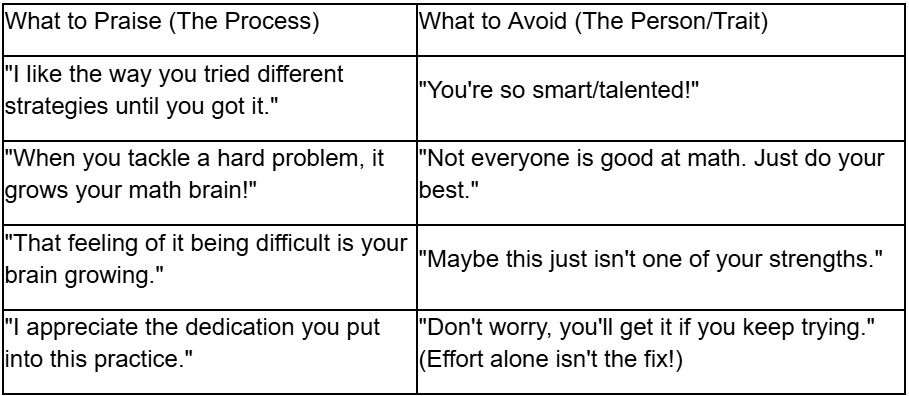
It feels natural to praise a child by saying, "You're so smart!" However, research shows this actually triggers performance avoidance. When we praise someone’s person or traits, they become terrified of losing that label. In studies, students praised for their intelligence were more likely to choose easy tasks to avoid looking "dumb," and nearly 40% actually lied about their scores after failing to maintain their "gifted" status.
To foster a genuine growth mindset, we must shift our focus to the process. Even "well-intended" phrases can accidentally signal a fixed mindset by suggesting that some people simply lack the "math gene" or a "natural" gift.
Analysis/Reflection: Labels, even positive ones like "gifted," can become cages. They create a "fear of looking stupid" that prevents us from taking the very risks required for mastery. We begin to view mistakes as a verdict on our identity rather than a data point in our learning.
3. The "False Growth Mindset" & Legitimizing Your Inner Critic
A "False Growth Mindset" occurs when we claim the identity without changing the practice. We often feel that a growth mindset is the "enlightened" way to think, so we "ban" fixed-mindset thoughts. Carol Dweck suggests a counter-intuitive fix: Legitimize the fixed mindset.
We are all a mixture of both mindsets. Rather than shaming your inner critic, you must identify your Fixed-Mindset Triggers. These are the moments when you feel your "fixed" voice taking over:
When students or colleagues aren't listening or learning.
Facing a setback in your work or teaching that makes you feel "defeated."
Receiving criticism that makes you feel "crushed" or defensive rather than interested.
Seeing someone else succeed in an area you value and feeling envious or threatened.
Analysis/Reflection: Naming these triggers is essential for managing "rejection sensitivity" or "failure anxiety." By acknowledging the voice that says, “I’m incompetent,” we can work through those feelings. For neurodivergent individuals, this is a vital tool to separate a temporary setback from a permanent sense of "brokenness."
4. The Invisible Hand of Peer Norms
The National Study of Learning Mindsets—a massive experiment with over 12,000 students—found that a growth mindset intervention (the "seed") only works if the "soil" (the environment) is supportive.
The data is compelling: in schools where peer norms supported the intervention, poor performance rates (D/F grades) dropped by a relative risk of 11%, and enrollment in advanced mathematics increased by 3 percentage points (a 9% relative increase). However, if the peer norm doesn't support challenge-seeking, students fear a "social price" for caring too much.
Analysis/Reflection: Self-help is not a vacuum. For a learner to truly embrace struggle, the community must make "public failure" socially safe. This is crucial for neurodivergent learners who may already feel socially vulnerable; they need an environment where "rigorous learning" is the norm, not a reason for social exclusion.
5. The Brain as a Plastic Muscle
At the heart of the "Brainology" concept is a powerful neuroscientific reality: the brain is not a static vessel. It is a plastic organ that forms new, stronger connections when it undergoes rigorous learning experiences.
Research by Anders Ericsson revealed a bold, counter-intuitive truth: practice is the only one thing that distinguishes geniuses from their talented peers. While "naturals" may coast early on, they often fail when they reach their limits because they never developed the skill of working through struggle.
Analysis/Reflection: This is the ultimate counter-narrative to the "medical model" of disability, which often views neurodivergence as a set of permanent deficiencies. Neuroplasticity reframes these challenges as skills not yet developed. It shifts the focus from "fixing a broken brain" to "strengthening a differently-wired muscle."
Conclusion: The "Not Yet" Philosophy
Growth is a journey, not a proclamation. It requires adhering to Dweck's three Cardinal Rules:
Learn, learn, learn! Learning is more important than looking smart.
Effort is the key. Effort is what ignites and grows your ability.
Embrace mistakes. Confront your deficiencies rather than concealing them.
Perhaps the most transformative word in the English language is "Yet." When you say, "I can't do this," you've closed a door. When you say, "I can't do this yet," you've mapped a path.
Your Turn: We all have a fixed-mindset persona that shows up when we’re stressed. Dweck suggests actually "naming" this persona to distance yourself from it. When you feel defensive or crushed by criticism, what does that persona say to you? Identifying that voice is the first step in moving from a proclamation of growth to a real journey of learning. What is your persona’s name, and what will you try next?