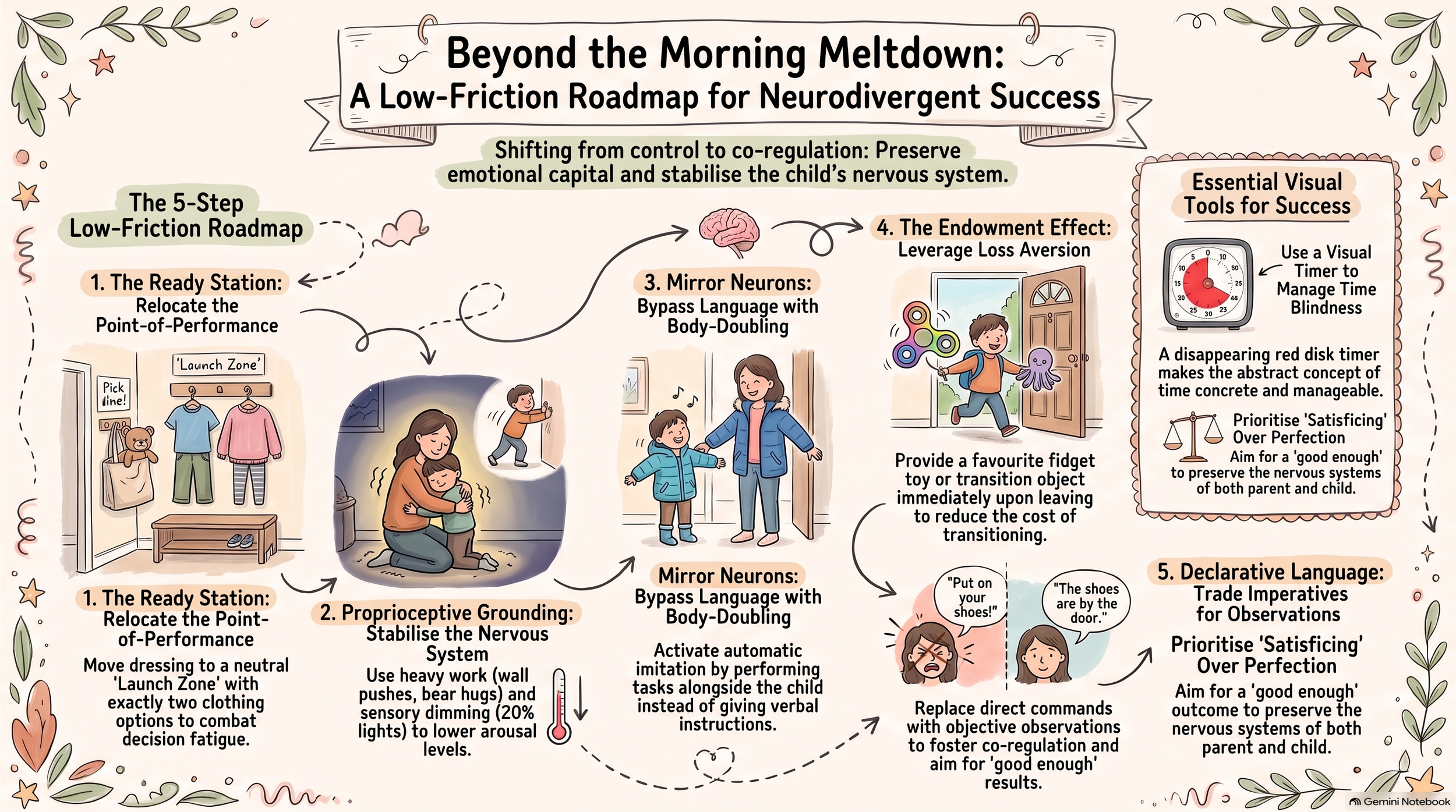
Beyond the Morning Meltdown: 5 Low-Friction Strategies to Hack the Neurodivergent Transition
The morning routine in a neurodivergent household often feels less like a schedule and more like a high-stakes power struggle. For many parents, the simple request to "put on your shoes" can trigger a total shutdown. This tension isn't a result of "bad behaviour"; it is the natural by product of a brain grappling with executive function challenges and time blindness.
When a child’s brain struggles to sequence tasks or perceive the passage of time, traditional parenting commands backfire, leading to decision fatigue and emotional exhaustion. To change the trajectory, we must look at the emergency morning flow. This means prioritising the stabilisation of the child's nervous system and glucose levels, using protein-heavy finger foods to prevent hangry spikes, before we ever ask them to engage with the world.
The following Low-Friction Morning Strategy Map offers a shift from a model of control to a model of co-regulation. By utilising behavioural science and sensory grounding, we can bypass common triggers and create a sustainable flow that preserves everyone’s emotional capital.
1. The Ready Station: Relocating the Point-of-Performance
One of the most effective ways to reduce morning friction is to move dressing and bag-packing out of the bedroom and into a neutral Launch Zone, such as a hallway or living room. In behavioural science, we call this optimising the Point-of-Performance, placing the necessary tools exactly where the action needs to happen.
This relocation reduces visual noise and cognitive load by removing the child from the distractions of their play space. To further combat decision fatigue, employ the Montessori limited choice strategy: provide exactly two clothing options. This simplifies the executive function requirement of choosing an outfit into a binary, manageable task.
“The bedroom is for sleep; the transition to school should happen in a neutral launch zone' to avoid bedroom based power struggles."
2. Proprioceptive Grounding: Stabilizing the Nervous System
Many neurodivergent children wake up with a dysregulated nervous system, often due to missing out on the sensory grounding typically provided by deep delta sleep. To stabilise them, incorporate heavy work, kinesiologic activities like wall pushes, firm bear hugs, or carrying a weighted backpack. These actions provide the proprioceptive input the brain craves to feel organised.
While heavy work grounds the body, we must simultaneously manage the environment to lower the arousal floor. This is achieved through sensory dimming: keeping lights at 20% and using brown noise or silence. By lowering the sensory ceiling, we prevent the overstimulation that leads to early-morning meltdowns.
3. Mirror Neurons: Bypassing the Brain with Body-Doubling
When a brain is tired or overstimulated, verbal instructions often go unprocessed. In these moments, body-doubling allows you to bypass the need for language entirely. By standing in the same room and performing a similar movement, such as putting on your own coat while they put on theirs, you activate the child's mirror neurons.
These specialised brain cells trigger automatic imitation. Rather than the child having to decode a verbal command and sequence the steps of getting ready, their brain simply mirrors the physical action they see performed in front of them. It turns a complex cognitive task into a simple, non-verbal social cue.
4. The Endowment Effect: Leveraging Loss Aversion with Transition Objects
Traditional parenting relies on "if/then" rewards, but behavioural economics shows us that loss aversion is a much stronger motivator. Instead of promising a reward for leaving the house, give the child a transition object, a favourite fidget item or toy, immediately upon leaving.
This utilises the Endowment Effect, where we value things more simply because we already own them. The psychological frame shifts from earning a reward later to keeping my toy now. The perceived cost of leaving for school is reduced because the child isn't leaving their comfort behind; they are taking it with them.
5. Declarative Language: Trading Imperatives for Observations
The way we speak can either trigger resistance or invite cooperation. Imperatives, direct commands like "Get your backpack!", often feel like a threat to a neurodivergent child's autonomy, sparking an instinctual "no."
To foster co-regulation, swap imperatives for Declarative Language. Use objective observations like, "I notice the shoes are still by the door, and the bus comes in five minutes." This invites the child to engage in problem-solving rather than resisting a demand. This approach prioritises "Satisficing", an economic concept where we aim for a good enough outcome to preserve energy.
Fed and dressed is a win; 'perfectly' dressed is a luxury. In economics, this is Satisficing—aiming for 'good enough' to preserve the parent's emotional capital."
Conclusion: The "Good Enough" Morning
The goal of a low-friction morning is not to achieve a picture-perfect, orderly exit. It is to preserve the nervous systems of both parent and child. To help manage time blindness, consider using a visual timer (like a Time Timer) that shows time as a physical red disk disappearing, making the abstract concept of five minutes concrete.
Success isn't found in perfection; it is found in a morning that feels manageable and keeps your relationship intact. Which one friction point in your current routine will you choose to remove tomorrow morning?